

- David Nkanta
- October 1, 2024
- GRaphicdriver
What Courses Do I Need to Become a Care Worker in the UK?

A professional UK care worker supporting an older adult in a bright, modern care environment.
If you’re considering a career as a care worker in the UK, one of the first things you may be wondering is:
“What course do I actually need?”
You may have seen the Care Certificate mentioned online. You may also have come across Level 2 or Level 3 Adult Care qualifications, safeguarding courses, medication training and other care-related programmes.
It can quickly become confusing.
The good news is that you don’t necessarily need to complete every course you see before applying for a care job.
What you need depends on the role, employer, setting and your existing experience.
The best approach is to understand the different types of training and then choose learning that supports your career goal.
What does a care worker do?
Care workers support people who need assistance with everyday life, personal care and independent living.

Care workers helping older persons with everyday activities, such as preparing a meal, walking safely, or assisting with daily routines.
They may work in:
– Residential care homes
– Nursing homes
– Home care
– Supported living
– Community settings
– Other adult social care environments
The role can include supporting personal care, daily routines, independence, meals, communication, record keeping, wellbeing and following care plans.
Because the role involves real responsibility, relevant knowledge and practical competence matter.
Do you need a qualification before becoming a care worker?
There isn’t one universal qualification that every person must have before applying for every care worker position.
Employers set their own requirements.
For people who are new to care, the UK government’s current workforce pathway provides a “new to care” starting point specifically for individuals with no previous sector experience.
This means your journey might look different from someone who already has years of care experience.
You may begin with introductory training, complete employer induction and continue building your skills once employed.
1. Care Certificate training
The Care Certificate is one of the most important things for new care workers to understand.
The Care Certificate standards set out introductory knowledge, skills and behaviours expected of people working in specific health and social care roles.
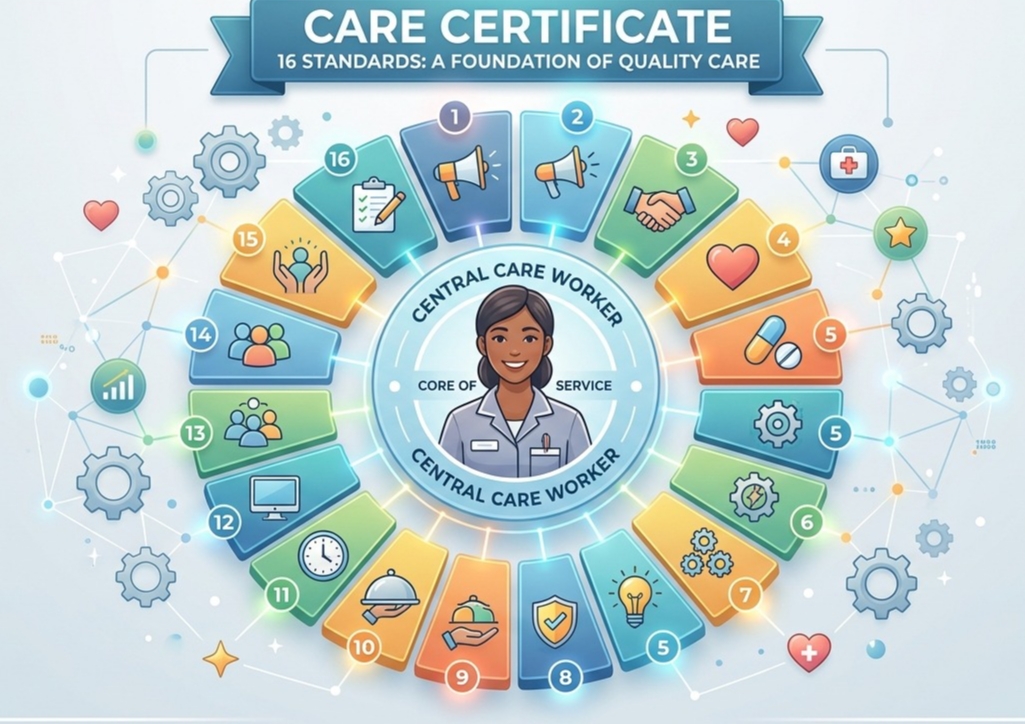
A professional infographic showing the CARE CERTIFICATE
They were updated in 2025 and now contain 16 standards.
The standards cover areas including:
– Your role
– Personal development
– Duty of care
– Equality and diversity
– Person-centred working
– Communication
– Privacy and dignity
– Fluids and nutrition
– Mental health and wellbeing
– Dementia
– Safeguarding
– Infection prevention and control
– Health and safety
– Basic life support
– Handling information
– Learning disability and autism awareness
However, there is an important distinction.
The Care Certificate standards are not themselves an accredited qualification.
They are standards that can be used to support induction and assess whether workers have the required introductory knowledge, skills and behaviours.
2. Level 2 Adult Social Care Certificate
You may also see the Level 2 Adult Social Care Certificate qualification advertised.
This is different from simply completing the Care Certificate standards.
The Level 2 qualification is Ofqual-regulated and is based on the same 16 standards, but it goes further by building and consolidating knowledge and understanding.
This distinction is important when comparing courses.
If a training provider says “Care Certificate,” ask what exactly you are receiving.
Is it:
– training based on the Care Certificate standards?
– a certificate of course completion?
– or the separate Level 2 Adult Social Care Certificate qualification?
Understanding the difference helps you make an informed decision.
3. Safeguarding training
Safeguarding is an important area of knowledge for anyone working in care.
Care workers may work with people who are vulnerable to abuse or neglect.
Training can help you understand:
– What safeguarding means
– Different forms of abuse
– Signs that something may be wrong
– Your responsibilities
– How concerns should be reported
– Why confidentiality and proper reporting matter
Your employer will also provide workplace-specific procedures.
4. Health and safety training
Care work involves practical risks.
You may need to understand safe working practices, infection control, emergencies and other workplace procedures.
Some training will be specific to your employer and work environment.
For example, your employer may provide induction covering procedures for emergencies, accidents, fire safety and other risks within the specific workplace.
The Care Certificate guidance makes clear that the standards do not replace all employer induction or setting-specific training.
5. First aid and basic life support
Basic life support knowledge can be valuable in care environments.
The Care Certificate standards include basic life support as one of the areas covered.
Depending on the job and employer, additional practical training may also be required.
6. Medication-related training
Some care roles involve supporting people with medicines.
Medication responsibilities can vary significantly depending on the role and setting.
You should not assume that completing an online medication course automatically authorises you to administer medicines.
Workplace procedures, competency assessment and employer requirements matter.
Training can nevertheless help you understand important principles around safe medication support.
7. Dementia awareness
Dementia care is another useful area of learning, particularly if you want to work with older adults.
Understanding dementia can help you develop a better appreciation of communication, behaviour, dignity and person-centred support.
8. Food hygiene and nutrition
Food and nutrition can also be important in care environments.
Care workers may support people with meals, hydration and healthy eating depending on their role.
Additional food hygiene training may be particularly useful for people whose responsibilities involve food preparation or handling.
9. Communication training

A care worker sitting beside an older adult, listening attentively and communicating face-to-face.
Don’t underestimate communication.
A care worker may need to communicate with:
– Service users
– Families
– Colleagues
– Nurses
– Managers
– Other professionals
Good communication can support dignity, safety and effective teamwork.
10. Level 3 Adult Care training for progression
If your long-term goal is to build a career rather than simply get your first care job, you should also think about progression.
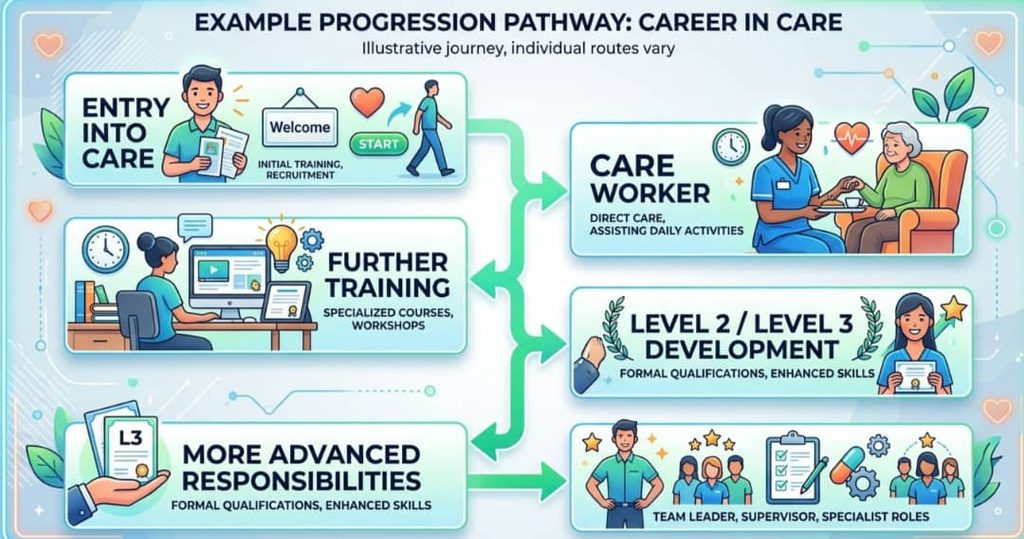
The current Care Workforce Pathway identifies progression towards Level 3 practice, potentially through a diploma or apprenticeship route.
This is why it is useful to think beyond:
“What certificate can help me get a job?”
and ask:
“What skills and qualifications will help me build the career I want?”
So, which courses should you take first?
If you are completely new to care, a sensible learning sequence could be:
Start with:
1. Introduction to Health & Social Care
2. Care Certificate-related learning
3. Safeguarding
4. Communication
5. Health and safety
6. Basic life support/first aid where appropriate
Then consider:
7. Dementia care
8. Medication-related training
9. Food hygiene
10. Adult Care qualifications for progression
You don’t necessarily need all ten before applying for your first role.
The right combination depends on your career goal.
How Deep Academy can help
Deep Academy offers flexible online learning across Health & Social Care and Adult Care, making it possible for learners to develop relevant knowledge alongside work or other responsibilities.
If you’re unsure which course is appropriate, don’t simply choose the longest or most expensive programme.
Start with your goal.
Want to enter care? Look for foundational training.
Already working in care? Look for development opportunities.
Want to progress into more senior responsibilities? Consider more advanced Adult Care learning.
The best course is the one that makes sense for where you are going.
Final thoughts
You don’t need to collect every care certificate available on the internet.
You need to understand your career goal and choose relevant training.
Most importantly, remember that training is not a substitute for practical competence, workplace induction or employer requirements.
Use courses to build your knowledge. Use workplace experience to develop your skills. Then keep learning as your career grows.
Frequently Asked Questions
Can I become a care worker without a qualification?
Some employers recruit people who are new to care and provide induction and training. Requirements vary, so always check the individual vacancy.
Is the Care Certificate mandatory?
The Care Certificate standards are widely used as an introductory framework for new workers, but the standards themselves are not an accredited qualification. Employers are responsible for ensuring appropriate training and assessment.
Is the Level 2 Adult Social Care Certificate the same as the Care Certificate?
No. The Level 2 Adult Social Care Certificate is a separate Ofqual-regulated qualification based on the 16 Care Certificate standards.
Should I take a medication course before applying for a care job?
It can be useful learning, but requirements and medication responsibilities depend on the role and employer. Completing a course does not automatically authorise you to administer medication.
Can I study care courses online?
Yes. Online study can provide a flexible way to develop knowledge, but practical workplace assessment and employer-specific training may still be required.
Safat
hello
Safat
testi
Safat
hi testing
Safat
testing with no child